latest news
An Inspiring Visit to the Jurassic Coast
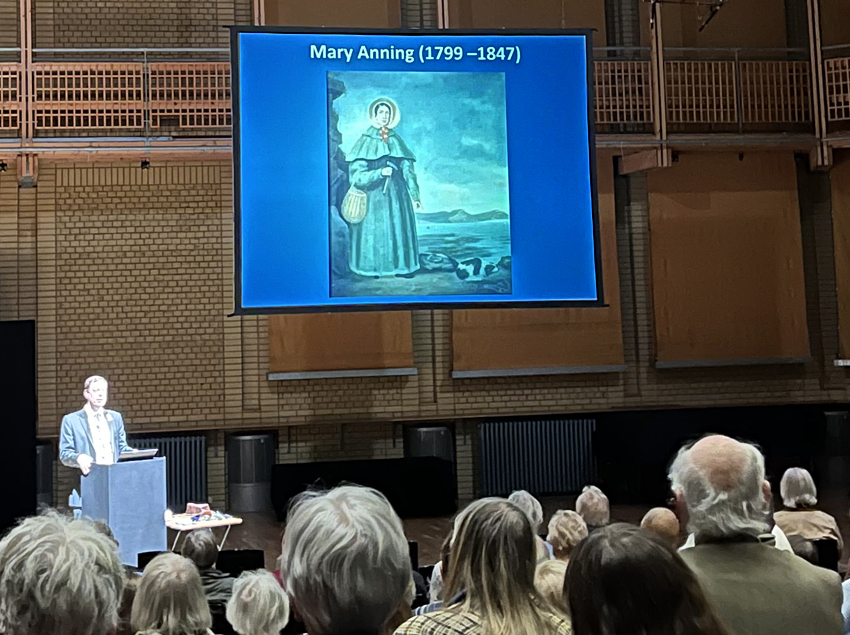
For our last lecture of the season, we were taken back to the distant past and to the Jurassic Coast, where Mary Anning, the pioneering fossil hunter (a wholly inadequate term) made extraordinary discoveries in the early 19th century.
Our lecturer, Aaron Hunter, was as passionate about her achievements in a male dominated world as he was about the fossils she uncovered. Her lack of any formal training and resources made these all the more extraordinary, both for the knowledge they brought to the history of the period but also, as we were shown for the sheer beauty of the fossils preserved in the ancient rock formations.
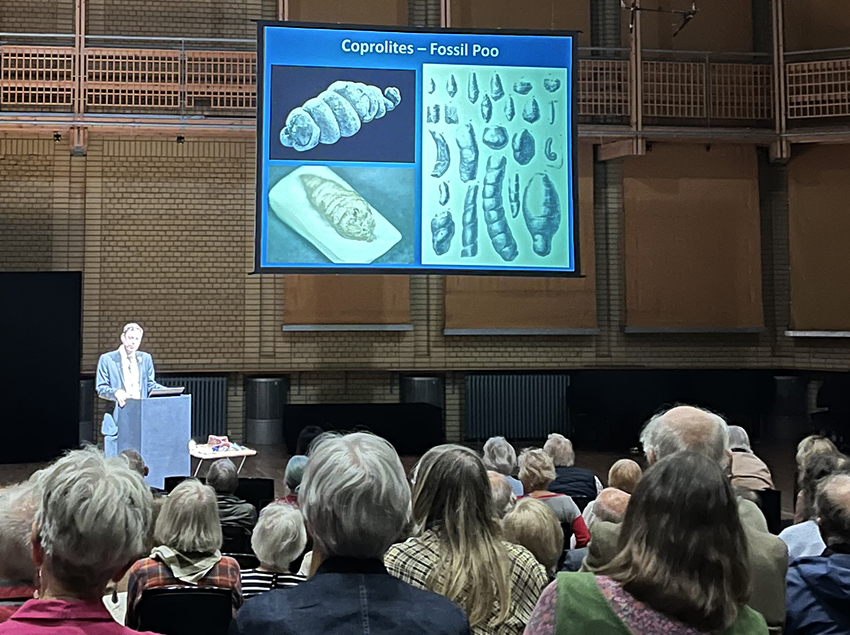
Aaron was especially enthusiastic about the images of fossilised dinosaur poo that he shared with us!
Those of us who have yet to visit Lyme Regis left the lecture inspired to do so, and one member, confessing to never having been to the Natural History Museum resolved to remedy that at the earliest opportunity!
Following the lecture, a number of members crossed the road to our second gathering at Noel’s Bar beside the canal, a convivial end to our 2025-2026 lecture programme.
2026-2027 LECTURE PROGRAMME

Di Retires!
To quote Shobhna : “Di’s key contribution over the last seven years has been the quiet and totally professional way in which she has ensured the smooth running of the Society. In a period of change and challenge she has been invaluable in helping to keep the Society on track, and her unstinting support for the whole Committee has always extended far beyond her role as Secretary. We are deeply grateful for all that she has given to The Arts Society Birmingham and we look forward to seeing her at many more meetings in the future.”
A tribute heartily applauded by all members in the audience. Di, on behalf of all the membership, “thank you”.

Art, Architecture, Music, Literature and Dance in Russia
IMPRESSIONS OF THE STUDY DAY
We learned, for example, that Peter the Great issued instructions on how to eat, but then, ironically, was noted for his destruction of furniture at rowdy parties in London! Again, and personally particularly worrying(!) was that in 1705 a tax was levied on beards, and, less worrying, that St Basil’s was originally white before acquiring its present dramatic tiling.
Most of us already knew something of the lives and works of Chekhov, Tolstoy and Tchaikovsky, if not so much about the sometimes stormy relationships between them, but the painter, Isaac Levitan, few of whose works are displayed in the West, was less known. The beauty of his landscapes was a revelation, at odds perhaps with our concept of the Russian countryside. But, intriguingly, for all his skill, Levitan was not at his best portraying figures, instead enlisting the help of Nikolai Chekhov, brother of the playwright, with whom Levitan was friends, although they fell out over Chekhov’s basing of a story (The Grasshopper) on Levitan’s affair with a married painter.
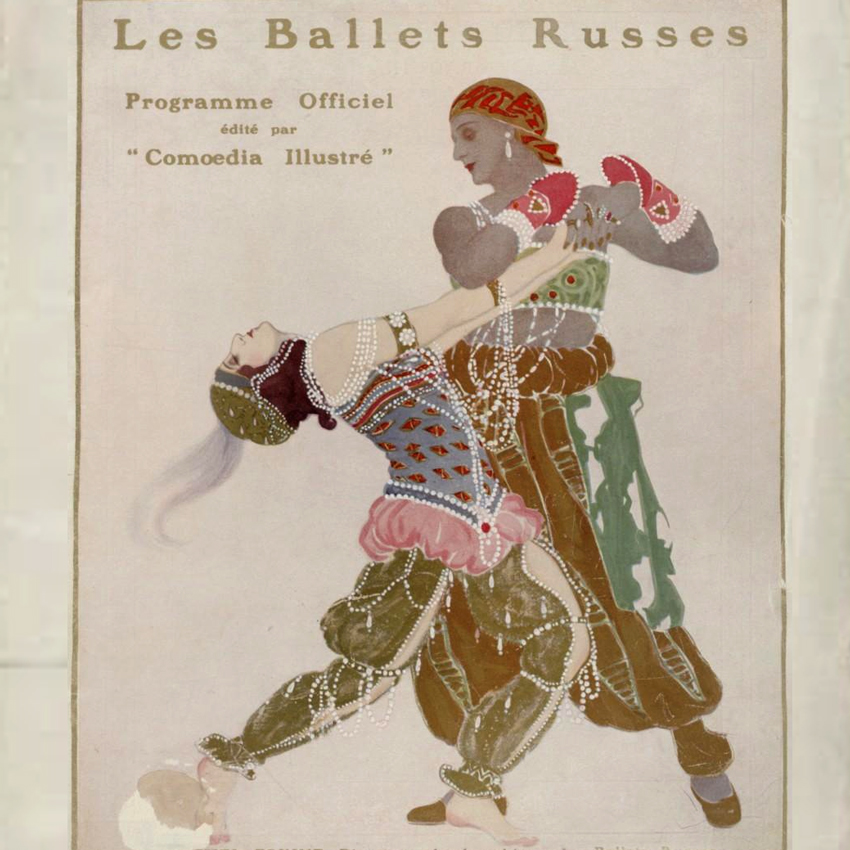
In her final lecture, the speaker traced the history of Ballet Russes from establishment by Diaghilev in Paris in 1909 through to its successor, Ballet Russes de Monte Carlo. Artists such as Bakst, Picasso and Matisse created settings of dazzling genius that matched scores by Stravinsky, Debussy and Ravel, choreography by Balanchine, and performances by Pavlova and Nijinsky. A tantalisingly short Pathe film clip, the only one known of the ballet in Diaghilev’s day, left us all wishing for more but also feeling we had truly ‘been to the ballet’!
A fascinating day.


THE CHRISTMAS STORY IN RENAISSANCE ART
A STUDY IN SYMBOLISM
2025 CHRISTMAS LUNCH & LECTURE
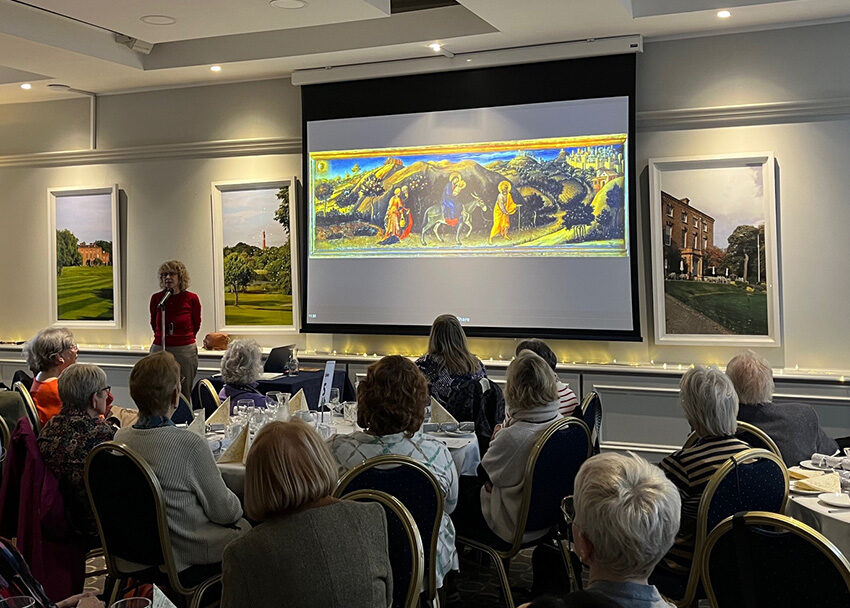
A fascinating lecture by Paula Nuttall, who illustrated and explained for us the degree to which symbolism was an essential element in the art depicting the Christmas story – a symbolism that would have meant much to contemporary viewers. Symbolism apart, this writer was also particularly struck by the prominence given to the midwives in these works.


Brenda Retires!

After eleven years organising Visits, Study Days and Special Events the Committee says goodbye to Brenda – although happily she will continue to be a member of the Society.
At the recent Christmas Lunch (yet another Brenda success), both former Chairman Jen Collins and current Chairman Shobhna Browne expressed their gratitude and admiration for all that Brenda has done for the Society.
At an estimate, during her eleven years as Visits Secretary, Brenda has organised over sixty Visits, Study Days and Special Events involving perhaps four thousand opportunities for members to visit, learn, socialise – or all three! Many many variations, but every one a winner!
Thinking just of visits with coaches, these have always had a distinctive ‘Brenda style’ from the traditional distribution of ‘rewards’ from the Cadbury shop to the relaxed, but clearly successful, care taken not to abandon stragglers, the latter having on at least one occasion involved the sending out of search parties to round up dilatory and blissfully unconcerned members. One lucky coach party even got cashback!
Study Days too have had their moments – from the pre PowerPoint days when it was all too easy to upend the slide carousel to the enthusiastic speaker perfectly content to keep talking right through the lunch break – to the dismay of the staff and members alike. All dealt with by Brenda in her own inimical way.
Brenda, on behalf of all the membership and of all those who have enjoyed the fruits of your labours, thank you.
THE WIND IN THE WILLOWS AND ITS ILLUSTRATORS
IMAGES FROM THE RIVERBANK AND TOAD HALL
OUR NOVEMBER LECTURE


Photos courtesy of Ludmilla Poole
(MORE) MUSIC OF THE SIXTIES
IMAGES FROM OUR FOOT-TAPPING OCTOBER LECTURE!


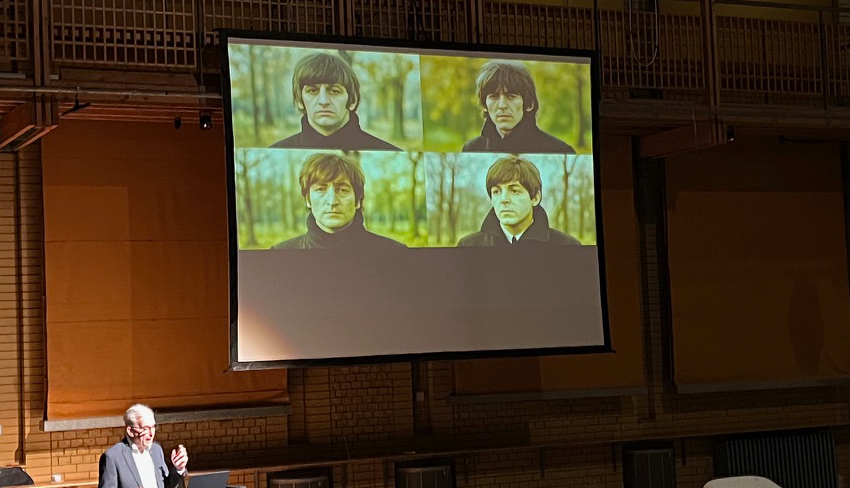

St Mary’s Convent – a Fascinating Visit to a Pugin Gem
For more about the Convent – and our visit – click here to see a report on the day by Susan Stockwell together with photos by Ludmilla Poole.


IMAGES FROM OUR FIRST LECTURE OF THE SEASON
A FASCINATING INTRODUCTION TO GOTHIC FURNITURE


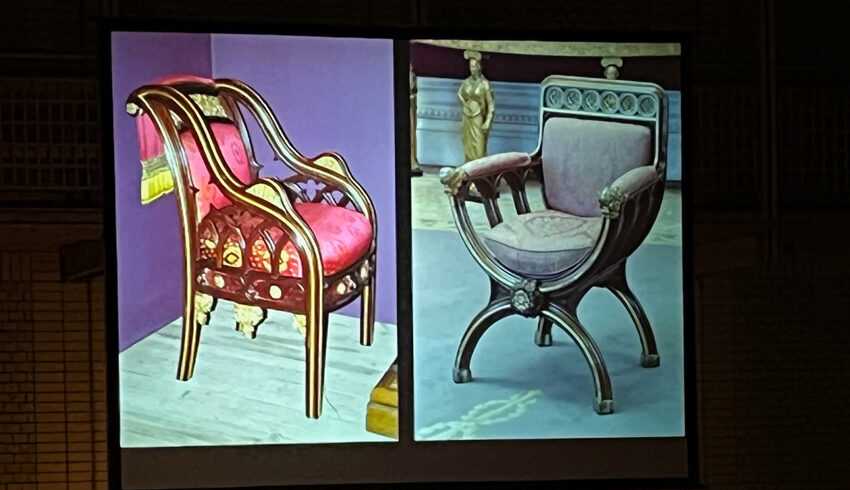

The History of the Tree in Art from Giotto to Klimt
our summer study day
Shobhna Browne writes:
As we admired the leafy terraces and the tree-lined fairways of Edgbaston Golf Club, we all wondered why we were traipsing indoors on such a perfect summers day. The answer came very quickly! There could hardly be a more erudite and passionate speaker on ‘The tree in art’ than Clare Ford-Wille, an art historian and lecturer associated with both the National Gallery and the V&A.
Click here to read Shobhna’s full report.

Visit to Berkeley Castle &
Dr. Jenner’s House
‘Impressions of a Grand Day Out’ by Anthony Collins
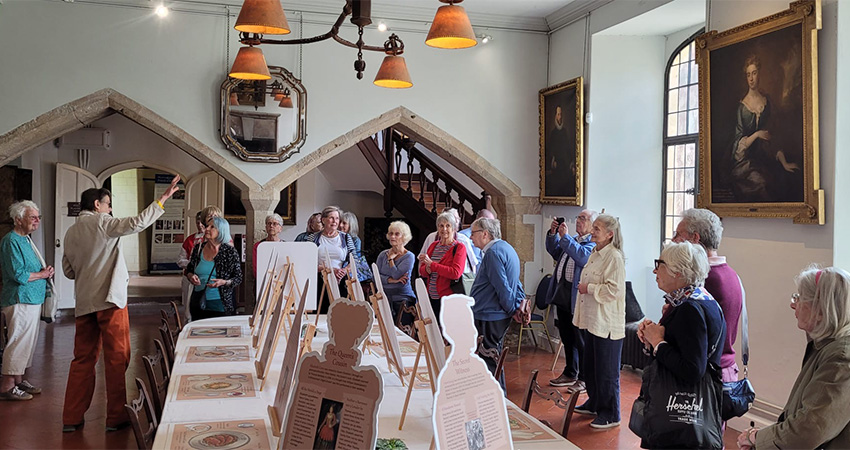
Thirty-six members and friends of the Art Society, led by Brenda, enjoyed a fascinating day which included visiting Berkeley Castle, seat of the Berkeley family for nearly nine centuries, the nearby home of Dr Edward Jenner, pioneer of smallpox vaccine, and the magnificent Berkeley church, with Jenner’s grave and the tomb of Lord Thomas Berkeley who fought for Edward III at Crecy.
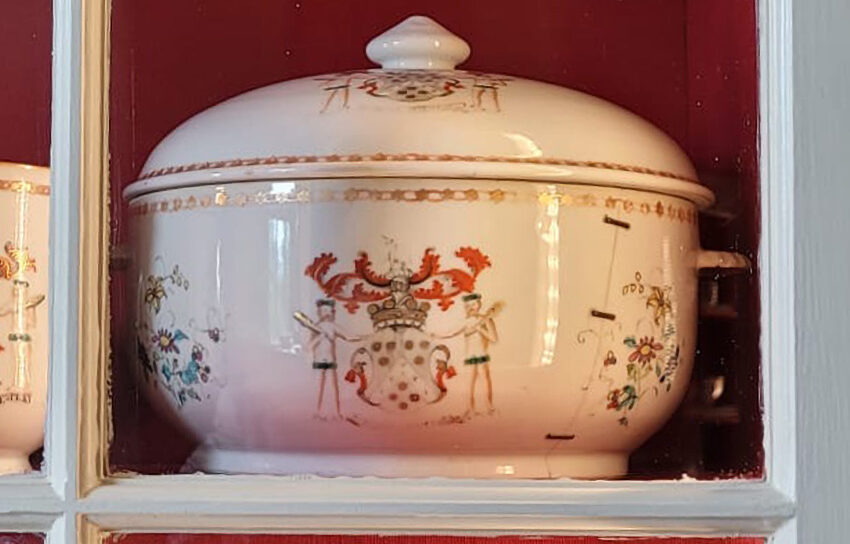
There was much to take in, top of the list being the probable site of the murder of Edward II. We were particularly blessed by having a wonderful guide in Eleanor Taylor who walked us through the many rooms of the castle, most recently made famous as the set of Wolf Hall. She enlivened our visit with stories of the Berkeleys who in the eighteenth century ordered their dinner service from China, only to find when it was delivered that instead of lions being shown as part of the coat of arms, they depicted what appeared to be two cave men supporting the family crest!
Currently undergoing restoration, Dr Jenner’s house was nevertheless most interesting, not only for its beautiful Georgian furniture but also for giving a better understanding of the discovery of the vaccine and its insight into Jenner’s other interests and exploits such as his air balloon flight as far as Birdlip on the A417.
Whether it was the terraced castle gardens with every rose determined to show its best, the fascinating history of the Berkeley family or seeing the home of Dr Jenner it was a day to remember.
With grateful thanks to Anthony and Fiona Collins, Rob Bromley and The Chairman for the photos of the day.


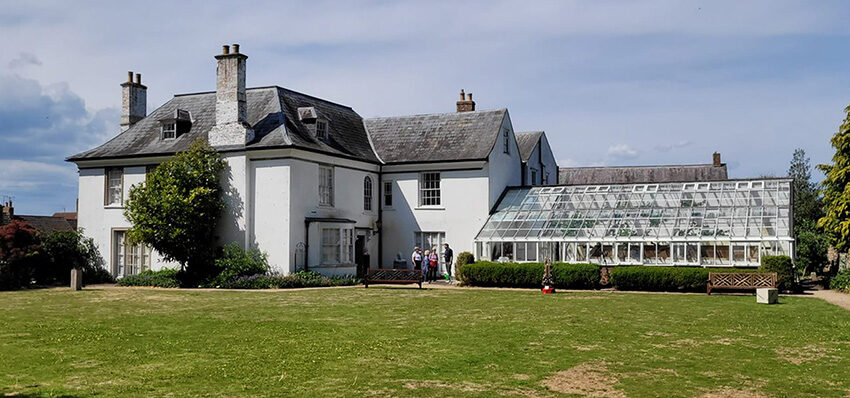

UNRAVELLING THE SILK ROAD
with Chris Aslan
‘Impressions of an Outstanding Study Day’
by Chrissie Twigg
He must have learnt some tricks from the literate and numerate Iranian born Sogdian traders who allegedly put honey on the lips of their babies to make them sweet talking and gum on their fingers so money would stick. Funny, generous and a born Silk Road salesman, many of us were clamouring to join one of his privately led small group tours by the end of the day.
Chris transported us along the vast network of ancient trade routes from China and the Far East to the Mediterranean learning about the economic exchanges of bamboo, ginger, rhubarb (!), cotton, herbal medicines, gold coins, perfume, olive oil, dates, nuts and many other goods.
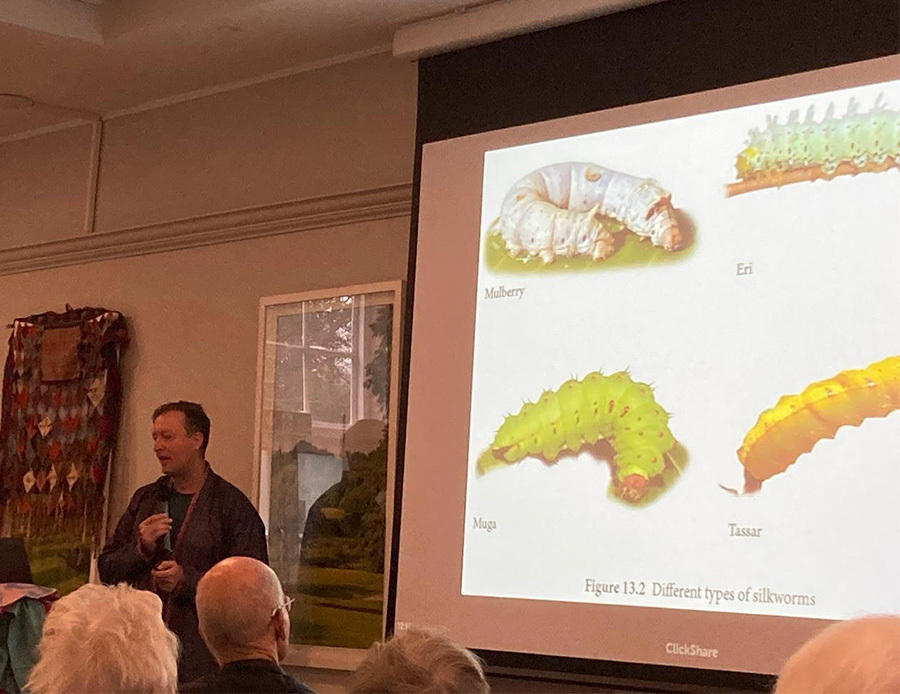
We learnt about how tortuously difficult sericulture is – that is the production of silk and the rearing of silkworms who require vast quantities of fresh mulberry leaves and near silence so they can munch undisturbed. “Such divas!” as Chris exclaimed. No one was left in any doubt that producing and dying silk with onion skins or madder root or Afghan zok was an exhausting, labour intensive BIG palaver.
Cotton production was equally beset with problems not aided by British colonialism in India nor, later, competing cheaper American cotton. Ghandi ensured cotton’s historical importance by vowing never to wear any clothes he hadn’t spun himself. He wore khadi, a hand spun and woven natural fibre to signify the struggle for freedom of the Indian subcontinent. He encouraged everyone to learn to spin and weave and his Indian flag depicted a spinning wheel as a sign of enslavement but also independence.
After three fascinating lectures we too were spinning with facts and rich imagery from Chris’ colourful slides and slipped off into the late afternoon dreaming of travels in foreign lands.


The White Mantle of Winter
Impressionist Paintings of Snow
Jean Pratt – with photos by Ludmilla Poole
As a group they were particularly influenced by Japanese artwork in prints obtained from what came into the country as wrapping paper…
However public approval was slow in coming until “the godfather of Impressionism” Paul Durand-Ruel, a French art dealer, became interested in their work and bought outright instead of “on sale or return” as was the norm. The impressionists became popular and, especially Pissarro, wealthy while he in his turn gave support to Gaugin and Cezanne.
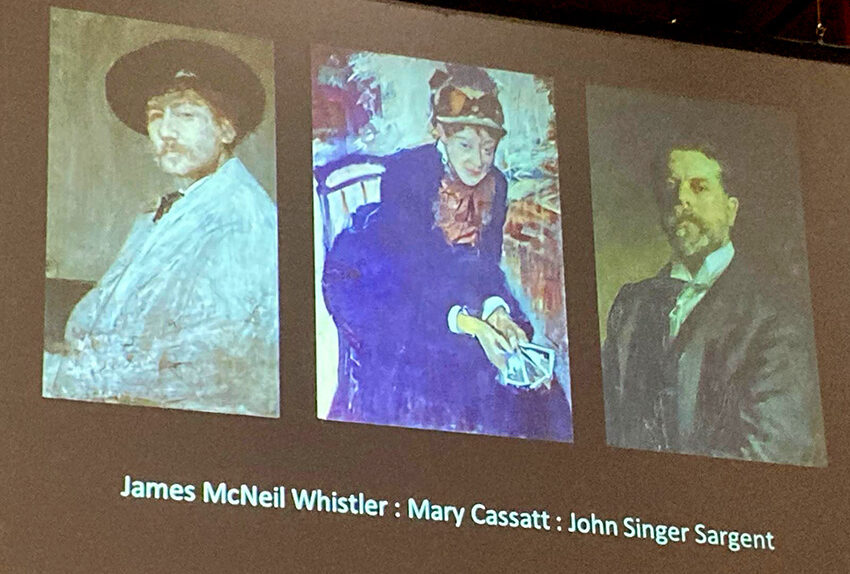
Meanwhile the American Impressionists including Whistler, John Singer Sargent and Mary Cassatt were making their mark, as were Childe Hassan and Willard Metcalf who travelled to Paris to study at the Academie Julien. Their ideas were similar to, but work more structured than, those of the French.
With a final quotation from Longfellow’s poem “Snowflakes” Julian Halsby concluded his interesting and informative lecture, illustrating most effectively the “White Mantle of Winter”.


CHRISTMAS LECTURE AND LUNCH
Norman Rockwell Great American artist or mere illustrator
‘Impressions’ by Chrissie Twigg
John Ericson began our festive lecture with a memorable joke about a rendezvous between a husband and wife which teed us up gently for a lecture on the artist and 3-times married family man, Norman Rockwell. Still largely unfamiliar even today to a UK audience, Rockwell was an astonishingly prolific twentieth century American artist and illustrator with approximately 5,000 finished works. His reputation developed from his 50-year association with the popular Saturday Evening Post for whom he provided some 320 covers. In addition to this collaboration, he had commercial arrangements with clients such as Parker pens, Kellog, Pepsi Cola and Coca Cola. It is, perhaps, his images of Father Christmas for the latter that are seared in our psyche.
Rockwell described himself as “a storyteller with a brush”, and often including himself in his illustrations. To his critics his work was schmaltzy and rather saccharine but to his many fans (including those storytelling filmmakers Steven Spielberg and George Lucas who were both avid collectors), he was a humorous, whimsical and in later life, serious, painter. Rockwell’s response to his critics was that he could see the world wasn’t perfect, but he chose to present it as if it was.
His political awakening came when he left the Evening Post and gained more artistic freedom with Look magazine. His powerful picture of black child, Ruby Bridges, making history when flanked by four suited men on her way to a white school depicted, for Barak Obama, the incident which led him to the White House. When he was President, he asked for the painting to be loaned and shown in the West Wing, and he invited Ruby Bridges to view it with him.
John asked us to consider whether Rockwell was an illustrator or an artist and concluded by encouraging us to visit the Norman Rockwell Museum in Stockbridge, Massachusetts. Whilst the audience had divided opinions on the question, there was a consensus that we had listened to an excellent talk and a murmur of temptation around the room for a Stateside visit.


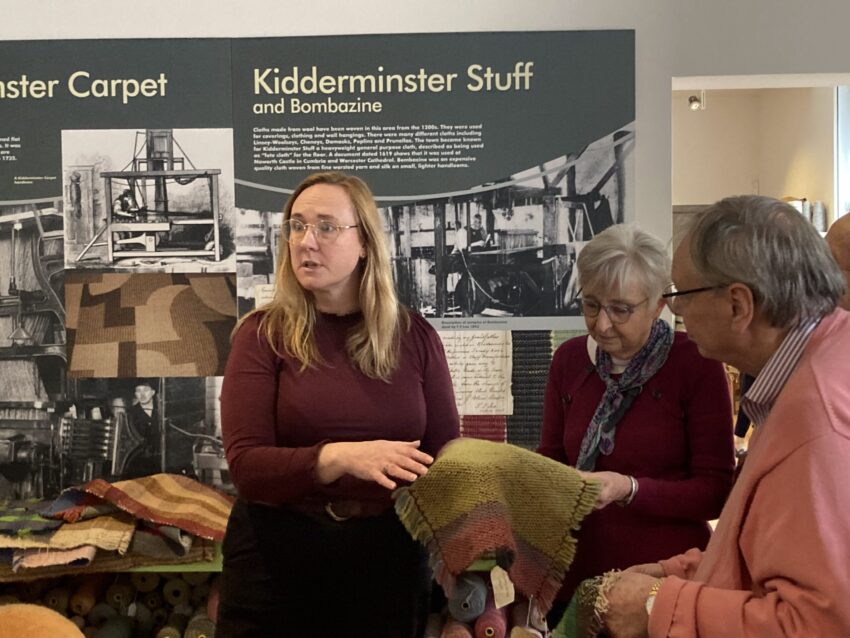
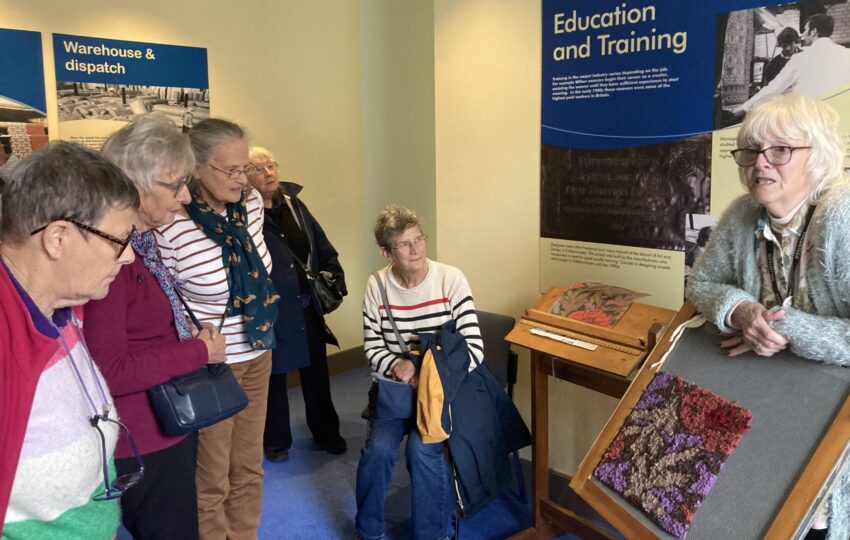
KIDDERMINSTER CARPET MUSEUM
The Chairman’s Impressions
“Kidderminster Stuff”, a heavyweight general-purpose cloth with a variety of uses including floor covering, was the first important cloth to be woven in the town in the 17th century. Throughout the 18th century demand for carpets grew. Handwoven Kidderminster carpets were proudly on show at the 1851 Great Exhibition. Then came power looms, the town expanded, and the factories and looms got bigger. The 20th century saw the introduction of wall-to-wall carpeting creating an ever-increasing demand, and by the 1960s about 15,000 people worked in the industry.
However, it was not to last. A new type of “tufted”carpet from the U.S.A appeared, which was much cheaper to produce, and which led to the demise of the industry as a major employer. Today only one dedicated mill survives.
The Museum is a centre of heritage art and industry. After a welcome warm drink, we were given a most comprehensive tour of the exhibition galleries, beginning with a history of carpet design down the centuries. We were able to create designs ourselves – with some computer help! The second gallery was all about the evolution of carpet manufacturing – from “stuff” to Wilton and Axminster weaving.
We then learned about the families who worked in the industry down the generations. Brightly and colourfully illustrated, there are many informative wall displays, photographs and videos. We also handled a variety of artefacts, carpet samples, bobbins and shuttles. Finally, we watched volunteer staff spin wool and work hand looms and large power looms. These last were most impressive in size and extremely noisy, with the final machine creating both Wilton and Axminster rugs.
It all made for an absorbing and stimulating day out. And the sun came out on the drive home!
With grateful thanks to Ludmilla Poole for the photos.


IMAGES FROM AN EXPLORATION OF 1960’S FILM
OUR FIRST LECTURE OF THE SEASON


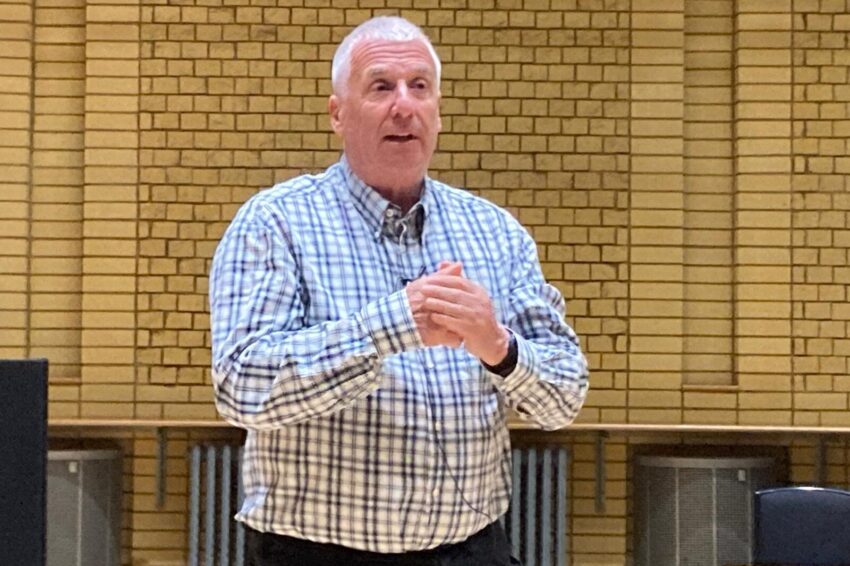
VISIT TO WOLLATON HALL – AN ENVIGORATING OUTING!
The Chairman’s Impressions
A group of Society members enjoyed a traditional coach outing to this fine Elizabethan building, which stands imposingly above the city of Nottingham. The Hall, built between 1580 and 1588 and designed by Robert Smythson who also designed Longleat and Hardwick Hall, is surrounded by five hundred acres of gardens and parkland which is home to herds of wild deer, both red and fallow.
We began our visit with coffee in a welcoming cafe situated in the stylish seventeenth century stable block. It was a steep climb to the front steps of the Hall, a taste of what was to come. A most comprehensive tour took us up many many steps, some steep and corkscrewing round to reach the Prospect room built on top of the Hall. This room commands an amazing view of the surrounding countryside over the treetops to the city and far hills. Yes, the climb was worth it! From the heights we then descended to the Tudor kitchen and cellars.
Nottingham City Council bought the estate in 1925. The Hall and grounds are well used for educational and recreational purposes by the city. Outdoor concerts and other events are regularly hosted and “Batman” was filmed here! The Hall also houses an extensive Natural History Museum including much about the art of taxidermy.
Many of us also enjoyed walks in the formal gardens and visited the Camellia House. This, an elegant Regency glasshouse built in 1823, is the oldest cast-iron-framed glasshouse in Europe and is said to be the inspiration for the Crystal Palace of 1851. Today it still houses some of the finest camellias in the country.
An interesting visit, at the end of which we certainly felt we had done our ‘steps for the day!’


Women Artists in Britain
Lecture by Amy Lim
For our last lecture of the season, Dr. Amy Lim based her lively talk on the current Tate Britain exhibition ‘Now You See Us: Women Artists in Britain 1520 – 1920’, and for this writer, apart from the wealth of talent her images showed us, the most shocking impression was learning the degree of prejudice and misogyny with which these artists had to compete.
We were told that Elizabeth Thompson, later to become Lady Butler, who had become famous through her depictions of military scenes with her Crimean War scene ‘The Roll Call’ (purchased by Queen Victoria), was nevertheless denied by voting sleight-of-hand Associate Membership of the almost exclusively male Royal Academy.
Indeed, we learned that it was to be over forty years before Annie Swynnerton, a painter of portraits and allegorical subjects, described as “one of the most daring female painters of the nude”, became the first Associate Member of the R.A.
These prejudices were compounded by a perception that watercolour was in some way an inferior medium, an attitude that had given rise to the creation of what became the Royal Watercolour Society, whose first full female member was Helen Allingham, a prolific and highly commercially successful painter of rural Surrey scenes who had spent three years studying in Birmingham.
The recurring, but entertainingly presented, theme of denial of opportunity left this writer wondering how many talented female artists work we will never, despite the excellent efforts of Dr Lim, have a chance to see!


Holland’s Golden Age Revealed
‘Impressions of the Day’ by The Chairman
This study day gave us a wonderful introduction to the Art of 17th Century Holland. Our lecturer was Jane E Choy-Thurlow, who in 2018 was made a Knight in the Order of Oranje Nassau for her knowledge and work in the field of the Arts.
Our day was divided into three lectures. Firstly: ‘Intimacies and Intrigues’. This gave us the background of ‘history’ paintings and the development of portrait painting, with ideas, subject matter and techniques developing from the works of the Italian Renaissance. Our second lecture was entitled ‘Reality Show or Illusion? Genre Painting’, and our third ‘Mirrors of Reality – Landscape and Still Life Paintings’.
All three lectures were most lavishly illustrated, and we were able to study works in depth and detail. Close up views revealed brilliant techniques used to create the illusion of texture and three dimensions, and we learned how compositions were built up and perspective subtly used. Jane also showed us examples of how light was employed to focus and direct our attention.
We were treated to the work of many artists from the century, but three stand out in my mind from a brilliant day, and we studied several works by each. Firstly Rembrandt. We saw how he used light and a radically inventive style of composition. This was well illustrated in “The Night Watch”.
The second was Frans Hals and his most famous painting “The Laughing Cavalier” – though he is neither laughing nor a Cavalier! This painting can be considered an early and brilliant “swagger” portrait, and we were shown several more examples of the genre.
The third is Peter Bruegel the Elder. In his work we see landscapes and people set in them, with whole series of stories and sub- plots evolving. “Hunters in the Snow “and “The Peasant Wedding “are two great examples of his work that we looked at.
It is fair to say I have rarely had a day go by so quickly, so absorbing and fascinating were the lectures. Many thanks to Jane E Choy- Thurlow.


VISIT TO BLETCHLEY PARK
‘Impressions’ by Joanna Good
Although we left Birmingham late due to a coach driver calling in sick at the last minute, we arrived at Bletchley in plenty of time to explore most of the displays and exhibits before our guided tours.
The original house, which is in remarkable condition with beautiful plaster ceilings and wood panelling was saved from demolition, along with some of the huts, in the 1980’s, by a chance comment about the importance of the site as the centre of code breaking in the war. It was extraordinary to discover that those working there, all of whom signed the Official Secrets Act, had said nothing, even to family and friends for about 35 years.
We were told about the processes of listening to and recording coded German Morse code messages, and the race to try and find ways to decode and understand what was being said. We learnt about brilliant young people working shifts, living in billets and travelling in in buses, boredom, monotony, tennis and amateur dramatics, and the constant striving to break a code which would change every 24 hours.
Occasionally there were ‘eureka moments’. We heard about the Bombe machine which was developed to speed up the process of working out the settings of the German Enigma coding machine, and the Colossus, the first electronic computer, used to break the code of the more complicated German Lorenz machine.
I was so impressed by the single-mindedness of all those young people who worked to crack the codes which allowed Britain to listen in to the German communications and ultimately to shorten the Second World War. They said nothing, and it was only decades later that some of them received recognition for the work they did.
There were plenty of exhibits and descriptions of the technical processes at Bletchley, and some wonderful photographs taken during the War. Exploring the basic wooden huts and tiny offices brought the working conditions to life. The weather was perfect, and we had a wonderful trip!


GRACE DARLING AND THE ART OF RESCUE
Like, I imagine, all the audience of Members and their guests, the writer was familiar with Thomas Brooks heroic image of Grace Darling rowing alone to the rescue of the passengers on the stranded paddle-steamer Forfarshire, but Dr. James Taylor introduced us to the wider phenomenon of Grace Darling that has endured for nearly two centuries since that night in 1838 – a phenomenon fueled by copious paintings of the rescue, many notable (incorrectly) for the small part apparently played by Grace’s father, William.
Feted by the nation, we learned that Grace, as well as being sought by portrait artists was besieged by a public anxious for the slightest glimpse of her, and deprived not only of privacy but also of countless locks of her hair! Accepting an invitation to the circus in Edinburgh, she only withdrew when made aware that she would be in the ring, and an enterprising London theatre producer hoped to have her rowing a boat across his stage – but he had to settle for an actress playing the part!
The Duke of Northumberland, possibly also seeing an opportunity to improve his poor public image, became her unofficial guardian, sending his private physician to treat the tuberculosis that claimed her life only four years after the events of 1838.
We were shown examples of the imaginative memorabilia, much in questionable taste, that has helped to keep her name in the public eye, but it as the ‘poster girl’ for the RNLI that our lecturer would rightly wish us to remember her.


EDWIN LUTYENS – AND OTHERS
Anthony Peers opened our April lecture by asking the audience how many had visited New Delhi, and hands shot up, although, sadly, this writer’s were not among them! Anthony, an architectural historian with experience of India, then took us on a tour of colonial India, introducing us to the varying styles of Indian architecture which the British encountered and then sought with difficulty to adapt and interpret to their own authoritative style. We were shown how the proposed layout of New Delhi drew inspiration from the boulevards of Paris, and how, designed against a background of increasing political unrest, (the viceroy, Lord Hardinge, having himself narrowly survived a bomb attack), it was intended to impress with its sheer scale and grandeur.
Lutyens, an architect hitherto known for his work on private houses in England, shared with his colleague Sir Herbert Baker, the creation of New Delhi, although their relationship was fraught.
Perversely though, the building we were introduced to that most impressed the writer was designed not by Lutyens, but by his deputy Arthur Shoosmith. The Garrison Church of St. Martin in Delhi employed three and half million bricks and given its fortress like construction we were not surprised to learn that the military found it entirely to its liking! So, apparently did Lutyens.
An interesting introduction to a vast, in every sense, subject.

National Gallery Study Day:
The Chairman’s Impressions
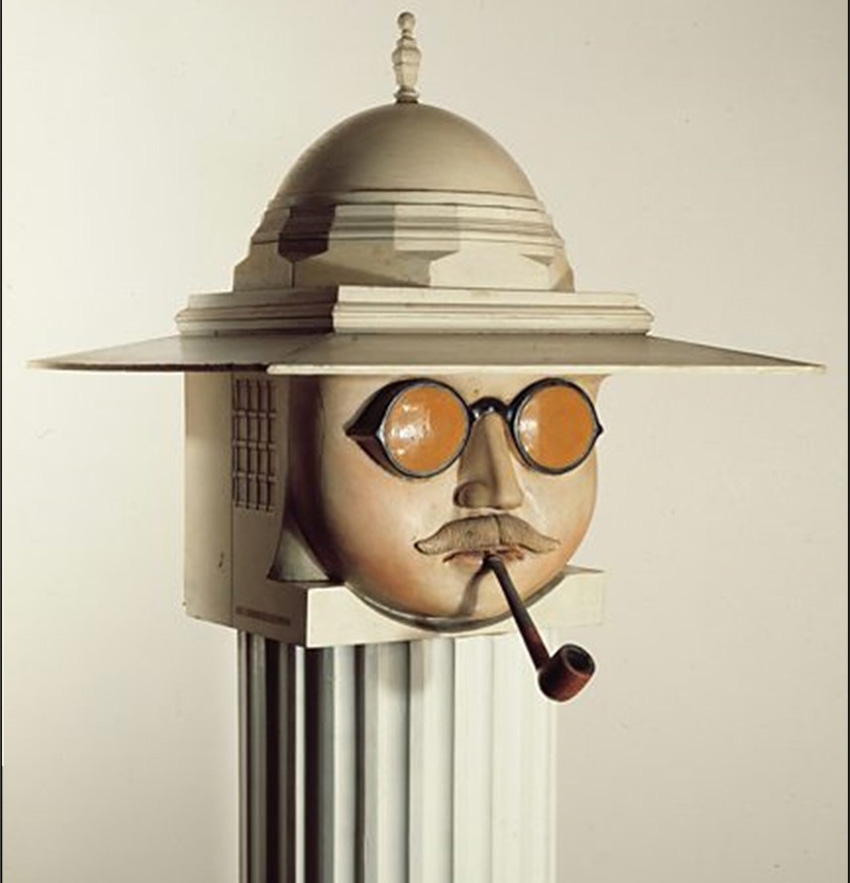
A sizeable group of Members and Guests gathered at Edgbaston Golf Club to enjoy a Study Day celebrating two hundred years since the founding of the National Gallery. Our very knowledgeable and entertaining speaker, Simon Whitehouse, took us in his three talks on a journey through the history and development of the Gallery and introduced us to some very talented women artists – sadly a tiny minority compared to their male contemporaries.
We learned that the National Gallery began with John Angerstein’s private collection of thirty-eight paintings, a number that, thanks to many bequests and to purchases, now exceeds two thousand three hundred works, and that the building we know today, which now includes the Sainsbury and Getty Wings, originally dates from 1831.
We were fascinated to learn about the different Directors, and about their priorities. Kenneth Clark opened the Gallery two hours early on FA Cup Day to allow visitors to see the Collection before the match, and in World War Two the paintings were sent to slate mines in North Wales for safe keeping while meanwhile daily piano recitals were performed in the Gallery.
Simon told us much about the development of artists’ techniques and materials, especially the invention and discovery of new colours, and explained how working surfaces had greatly changed over the years, plaster, wood panels, canvas and paper.
Finally, Simon spoke wittily about various notorious moments in the Gallery’s history including the theft of Goya’s ‘Duke of Wellington’, and several incidents of vandalism by way of political protest and demonstrations. May 10th is the actual day of celebration and to mark the event twelve paintings will be going on tour round the country.
Simon was rightly accorded enthusiastic thanks for an excellent day thoroughly enjoyed by this writer and by all those present.


Images from a Musical March Lecture ‘Music in Art’
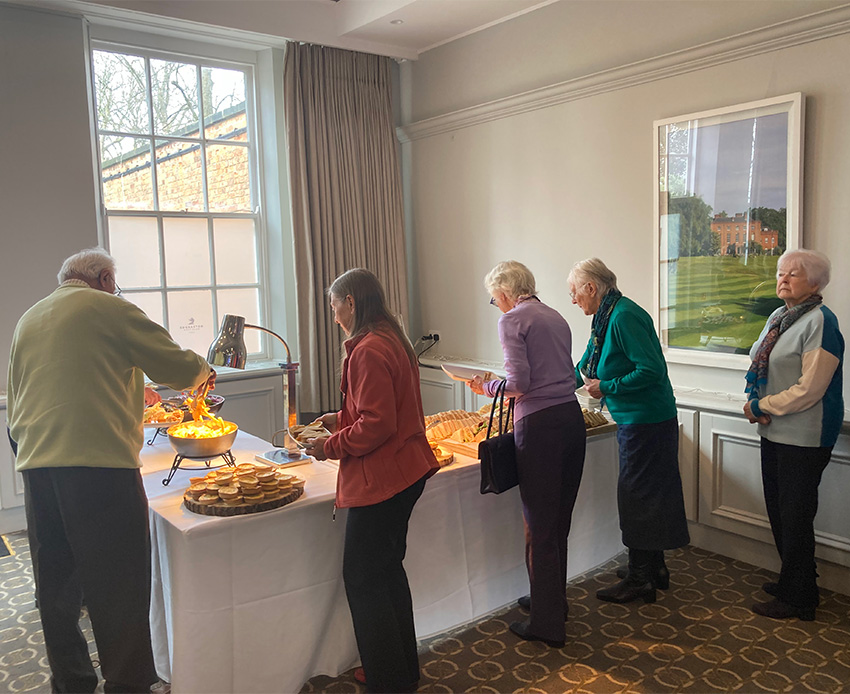
by Sophie Matthews



Picasso – The Boy from Malaga
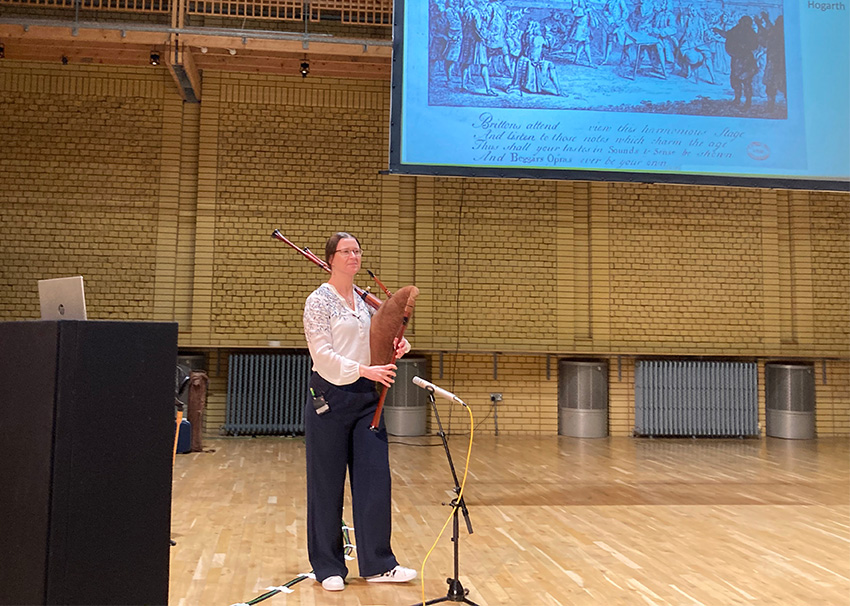
In a slight but unavoidable ‘change from the advertised programme,’ Dr. Jacqueline Cockburn took us back to Picasso’s earliest years as a child growing up in Moorish influenced late nineteenth century Malaga, a place far removed from its present-day affluence. The son of a painter and art professor, we learned that before he was ten he was borrowing his fathers’ brushes to display his own precocious skills.
Moving with the family, first to La Coruna in northern Spain, and then after the death of his younger sister, on to Barcelona, the city that became his spiritual home, the young Picasso was on his way to Paris, fame and a very different style of painting. But did we really believe that all this was down to his having, as a still born child, cigar smoke blown in his face?!
A fascinating introduction, which left this writer, and many others in the audience, thirsting for more. Perhaps that hope will be rewarded?
A Midsummer Night’s Dream
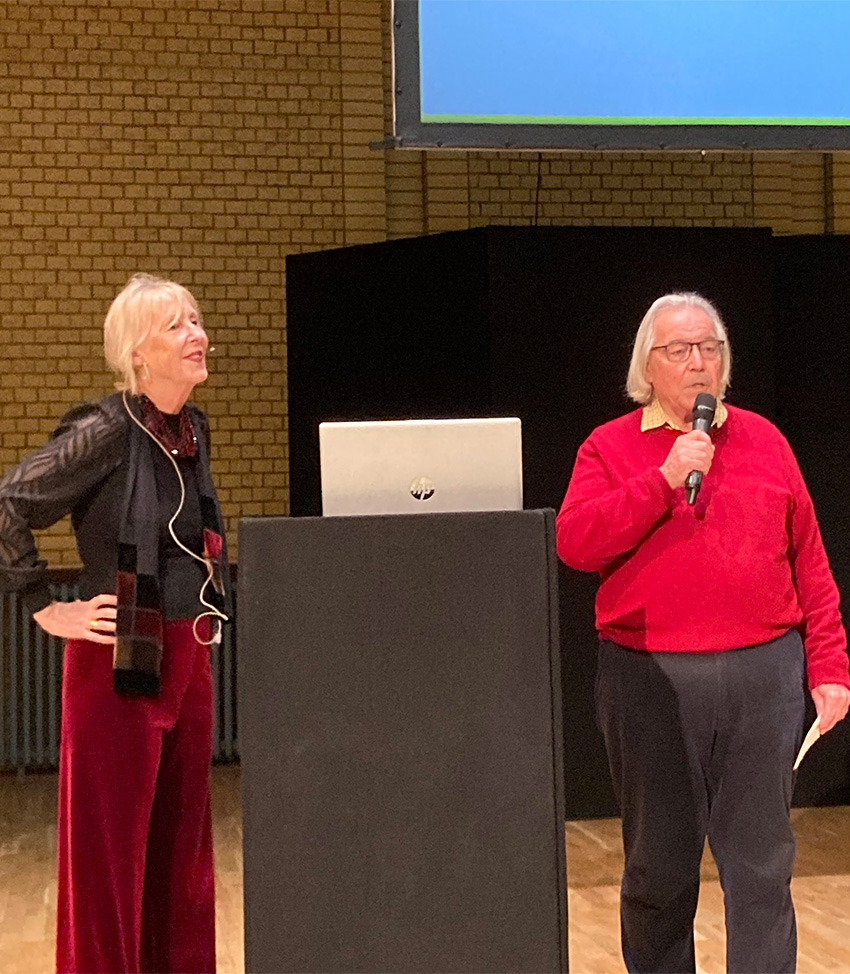
In a busy week for the Society, a group of members and their guests were treated to an outstanding and original staging of the play at The Royal Shakespeare Theatre in Stratford.
A perfect antidote to grey February – the smiles on the faces in the picture say it all!
Paul Nash – A Life in Troubled Times
David Boyd Haycock, our January lecturer, in his lavishly illustrated talk introduced us to the world of painter and poet Paul Nash, a world overshadowed by two world wars, in both of which Nash served as an Official War Artist, the accident of falling in a trench in 1917 while previously an infantry officer having probably saved his life.
We were taken through Nash’s time at the Slade, where he was part of what their teacher described as the school’s ‘last crisis of brilliance’, to haunting portrayals of the Menin Road and the devastated landscapes of the Western Front.
A pioneer in the use of watercolours, Nash became after the war a founder member of the Modern English Watercolour Society, his pastoral scenes of the inter-war period being created against a background of increasing ill health, possibly caused by inhaling stale gas at the Front.
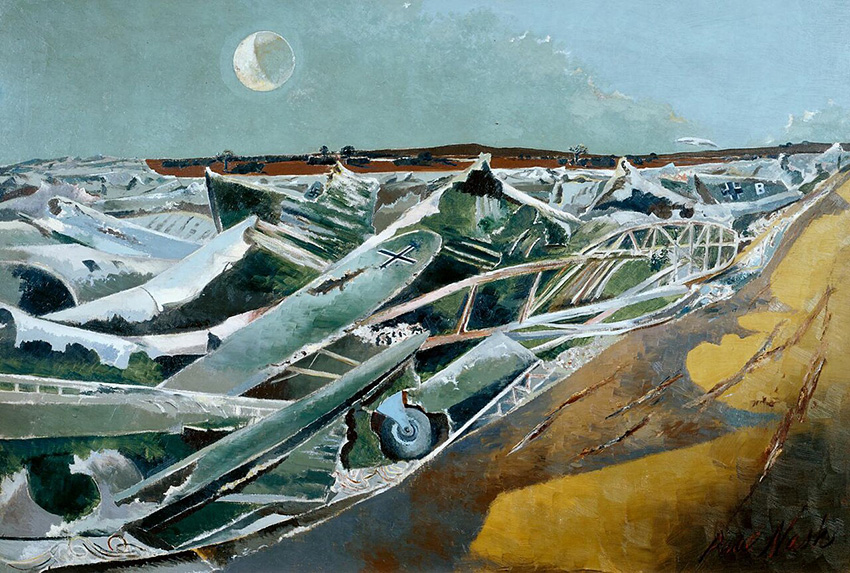
Returning to his role as a War Artist in 1939, Nash produced among other works the striking ‘Totes Meer’, a depiction of a sea of wrecked enemy aircraft in an Oxfordshire dump. We were shown this and many of his other works, together with images of and works by his contempories, and this writer came away feeling he had gained a valuable insight into one of the 20th century’s most influential artists, and with an urge to learn more!

A FESTIVE TREAT!
2023 CHRISTMAS LECTURE & LUNCH
‘A Member’s Impressions’ by Chrissie Twigg
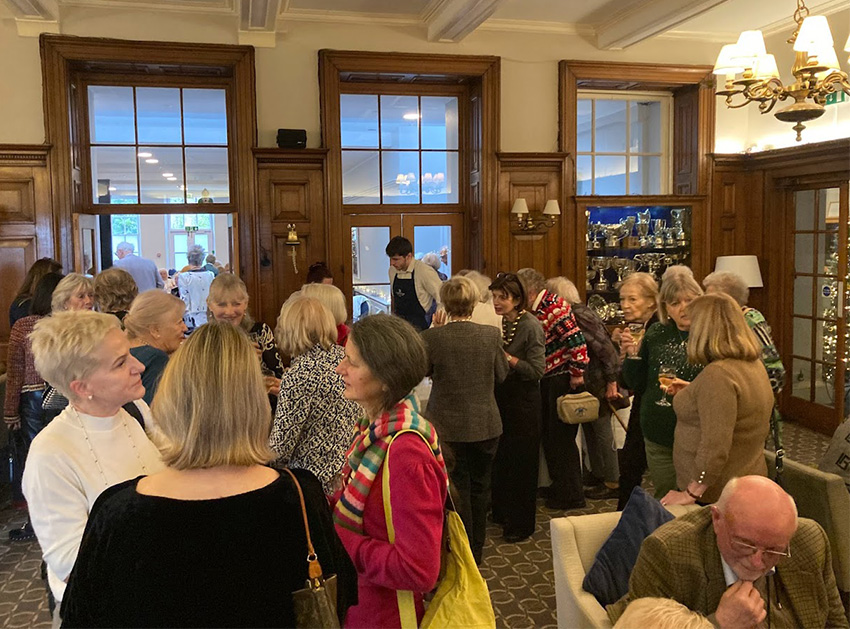
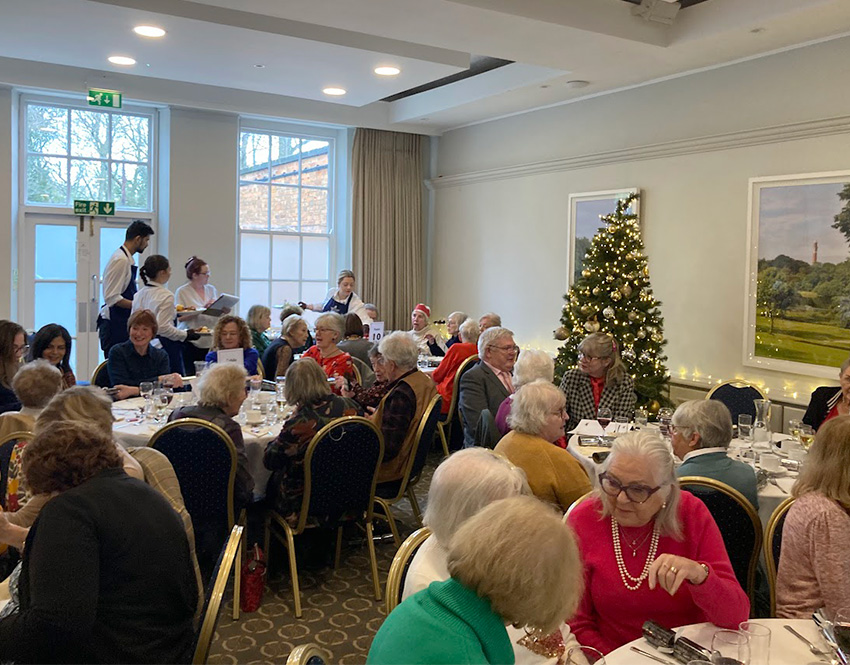
Having reported on the Coronation lecture, ‘Royal Babies’, I feel the job title of Royal Correspondent should be bestowed as I write about ‘A Tudor Christmas’! Siobhan Clarke, who has worked for Royal Historic Palaces for 20 years, gave another wonderful lecture based on her published work “A Tudor Christmas” co-written with Alison Weir (2018).
We might assume that our modern Christmas owes much to the Victorians (namely, Christmas crackers, Christmas cards and the Christmas Tree) but carol singing, present giving, mulled wine and mince pies were all just as popular in Tudor times.
Building on Pagan traditions, Christmas was a time when the agricultural workers enjoyed a twelve-day long festival, over which the Lord of Misrule held sway amidst much drunkenness, revelry, and gambling. Games we still play today – chess, backgammon, hide and seek, skittles, blindman’s buff, cards and dominoes were enjoyed by many Tudors, including Henry VIII.
The festivities climaxed with wassailing on Twelfth Night when a communal cup of spiced ale or cider was passed around for all to sip. This did not appeal to our post Covid audience! However, news that traditionally the Royal Household gave (as well as received) gifts from servants and subjects was greeted warmly, though we were amused to hear the late Queen Elizabeth II, on an economy drive one year, gave members of the household a Christmas pudding from Tescos rather than Fortnum & Masons! Apparently, the Tudor kings and queens wore their crowns on Christmas Day and feasted on plum porridge and boar’s head which was carried in accompanied by a trumpet fanfare.
However, you celebrate and whatever you eat, we wish you all a Very Merry Christmas!

Visit to Stourbridge Glass Museum & Red House Glass Cone
Tuesday 24th October 2023
The Chairman’s Impressions
The day was very full, busy, and most absorbing. Glass has been made in the area for over four hundred years, and the well laid-out displays in the museum show off the finest and the humblest of examples from throughout the centuries, together with a full history of thousands of years of glass making. Just staring at glass objects from ancient Egypt was mesmerising!
Some of our group also took part in a workshop, decorating and sand blasting their own glass Christmas trees. Presents truly in the making.
We then crossed the busy road for a guided tour of the Red House Glass Cone Museum. I was fascinated by the number and variety of techniques involved in producing glass objects, often of great delicacy and beauty. I also learned that “getting the sack” and “being in the doghouse” are expressions originating in the glass industry. The day then finished with a demonstration of glass blowing and turning, but if you are enthusiastic for more, there are master classes available!
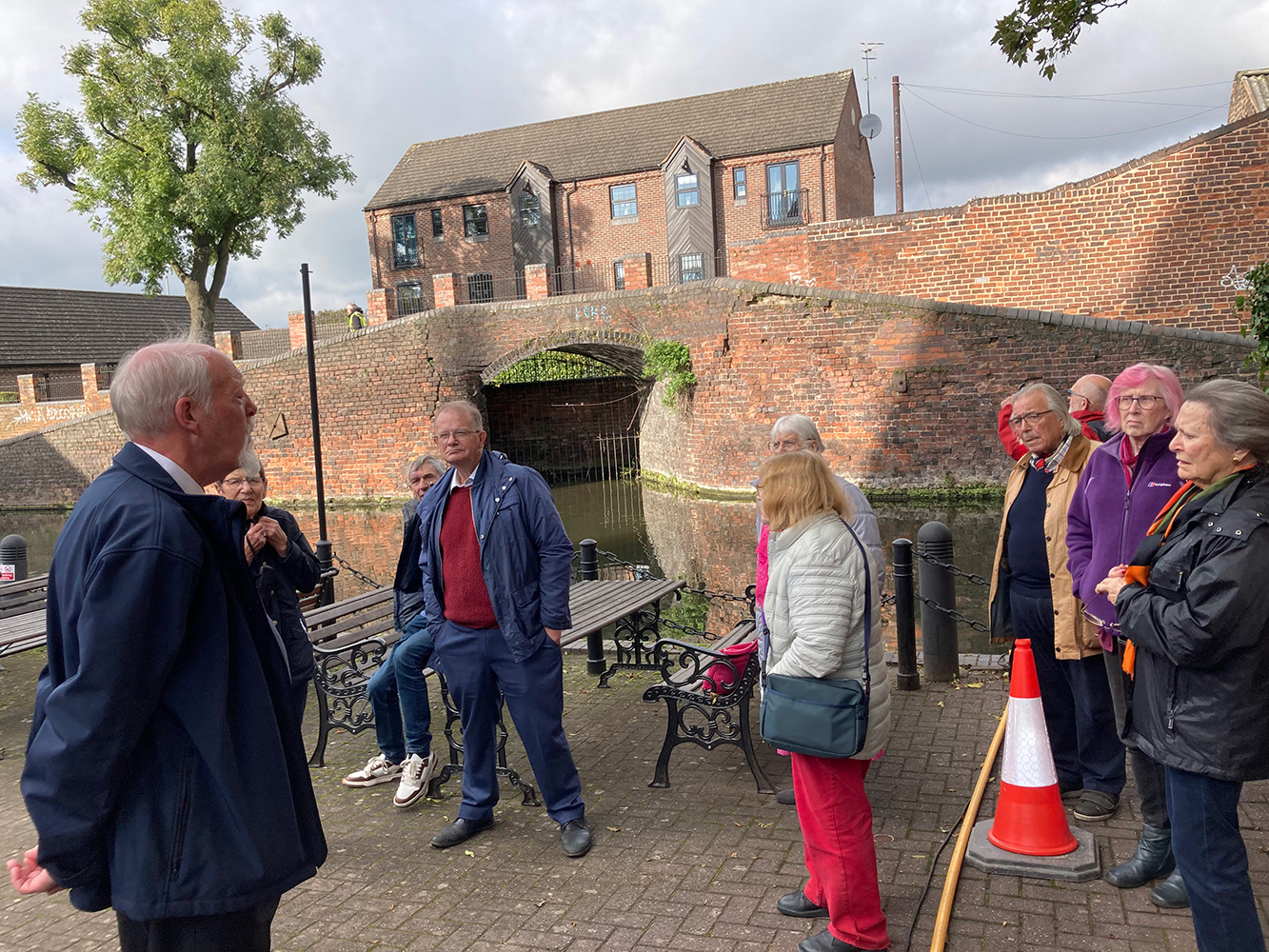

Big Ben – Without the Pain!
Tim Redmond, our October lecturer, was keen to emphasise just how many stairs there are to the top of Big Ben, and as a former guide to the tower he would know. His stunning images included views up the spiral stairwell from the bottom – and then, more breathlessly, looking down again from the top, as well as one of a strategically located defibrillator!
During our virtual tour, we learned about the various strong, and often opposing personalities behind the creation of the most famous clock and bell in the world, in particular lawyer and amateur horologist, Edmund Beckett Denison. The first Great Bell was cast overweight, and thanks to a deep crack, also off pitch. The second, after installation, also cracked, a disaster until the ingenious solution of turning the bell ninety degrees and reducing the clapper weight was found. Among many other fascinating details, the audience was asked whether adding (old!) pennies to the pendulum increased or slowed the movement – most, including the writer, wrongly opted for slowing!

Finally, and excitingly, Big Ben is soon to reopen to visitors – and even more excitingly there is now a lift! This member was certainly inspired to sign up.
Our First Lecture of the 2023-2024 Season – A True Collectors Item!
Collector or Hoarder? That was the question our speaker put to the audience gathered for our first lecture of the season. An uncomfortable choice for this writer, who inclines strongly towards the latter, but Marc Allum had no doubts which side of the fence he stood. A lifelong collector since becoming ‘hooked’ as a boy visiting Snowshill Manor and encountering the world of his hero, Charles Paget Wade.
From the ‘high’ of intercepting a rare Chinese vase on its way to the charity shop to the ‘low’ of a cleaner left holding the rim of another precious vase while the rest lay in fragments at her feet there seem to have been few dull moments in the life of this ‘collectaholic’. A second show of hands at the close of this fascinating account seemed to suggest he had gained some converts! Prudence, however, dictates that the writer should perhaps not be among them!

VISIT TO CAMBRIDGE
Tuesday 11th July
To read a member’s entertaining and illustrated account of this very successful ‘day out’ click here.
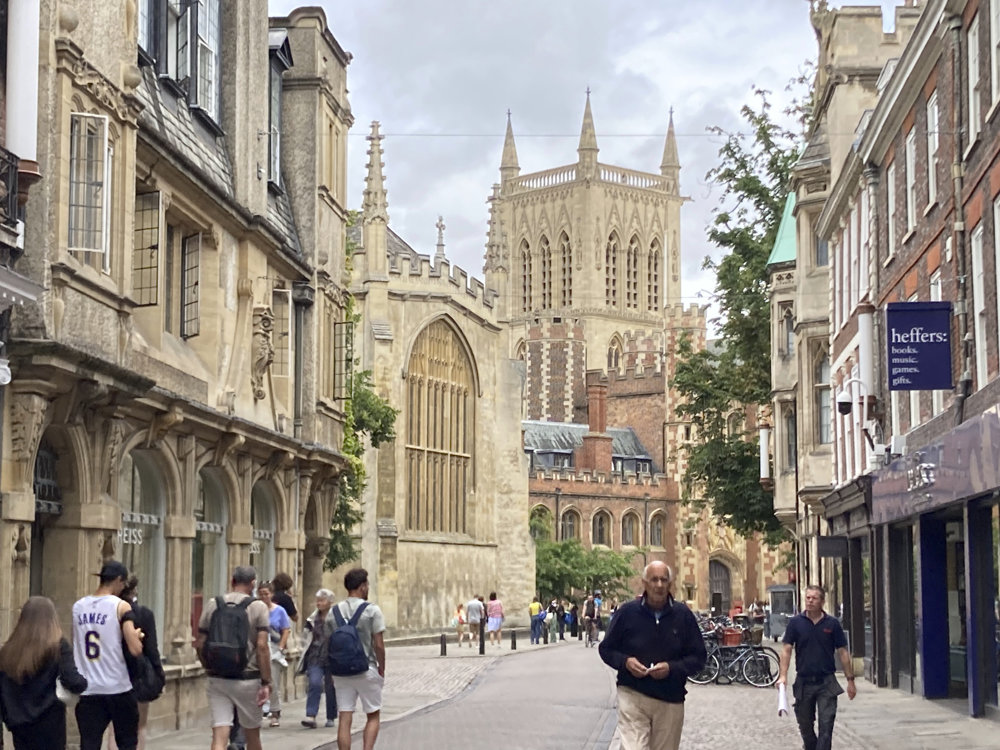

St Bartholomew’s – Edgbaston Old Church
Children’s Discovery Trail Completed
After being delayed by Covid restrictions, a small team of Society members has now successfully completed creation of this new Discovery Trail, which introduces children aged 8 – 12 years old to the church through a series of Questions designed to encourage them to explore the building, its art and artefacts, a corresponding Answer sheet also being supplied – afterwards!
Pictured is the small gathering held to mark the formal handover to the vicar, Charlie Butler, of the Trail, since when it has been enthusiastically trialled by a group from a local school.
For more information about access to the Church contact: office@edgbaston.church

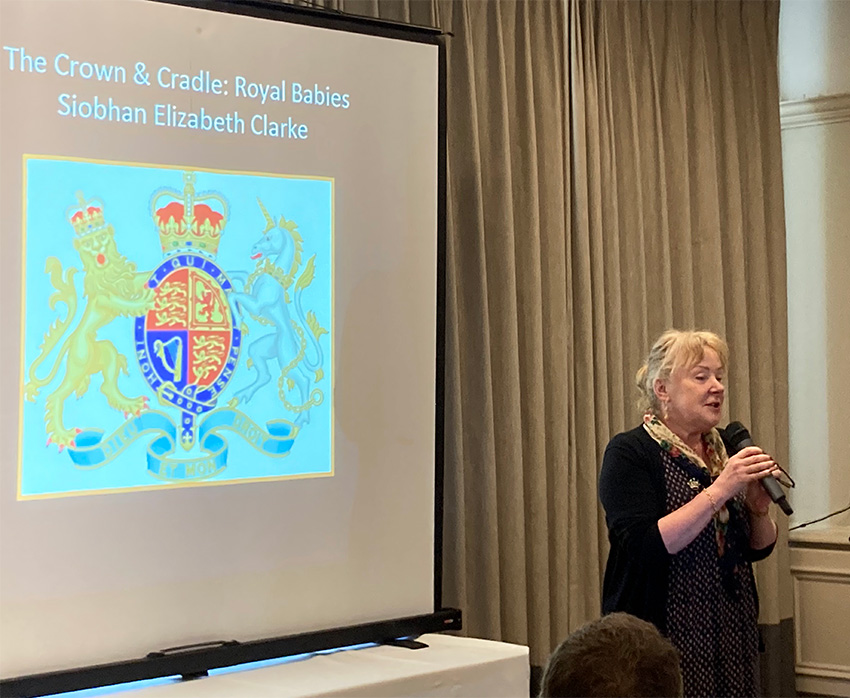
CORONATION LECTURE AND LUNCH
For a member’s impressions of this event please click here.
To mark the Coronation of King Charles III, we were back at Edgbaston Golf Club to enjoy a special lunch and an excellent lecture by Siobhan Clarke on ‘The Crown & The Cradle.’
So well received was this that we have already booked Siobhan to return for our Christmas Event in December to tell us about ‘The Tudor Christmas’.
TEMPLE NEWSAM – A yorkshire gem!

Chairman Kim Duce ponders the second largest wine cooler in the world at Temple Newsam, but reports that: “sadly it was empty at the time of our visit”!
Dating from about 1705 and weighing 80kgs, wine coolers of this type were the ultimate status symbol designed to ostentatiously flaunt the wealth and power of the monarch to visiting aristocrats and dignitaries. This impressive example narrowly escaped being sold abroad in 2010 before being ‘saved for the nation’ and Temple Newsam.
For a ‘Members Impression’ of this successful visit please click here.
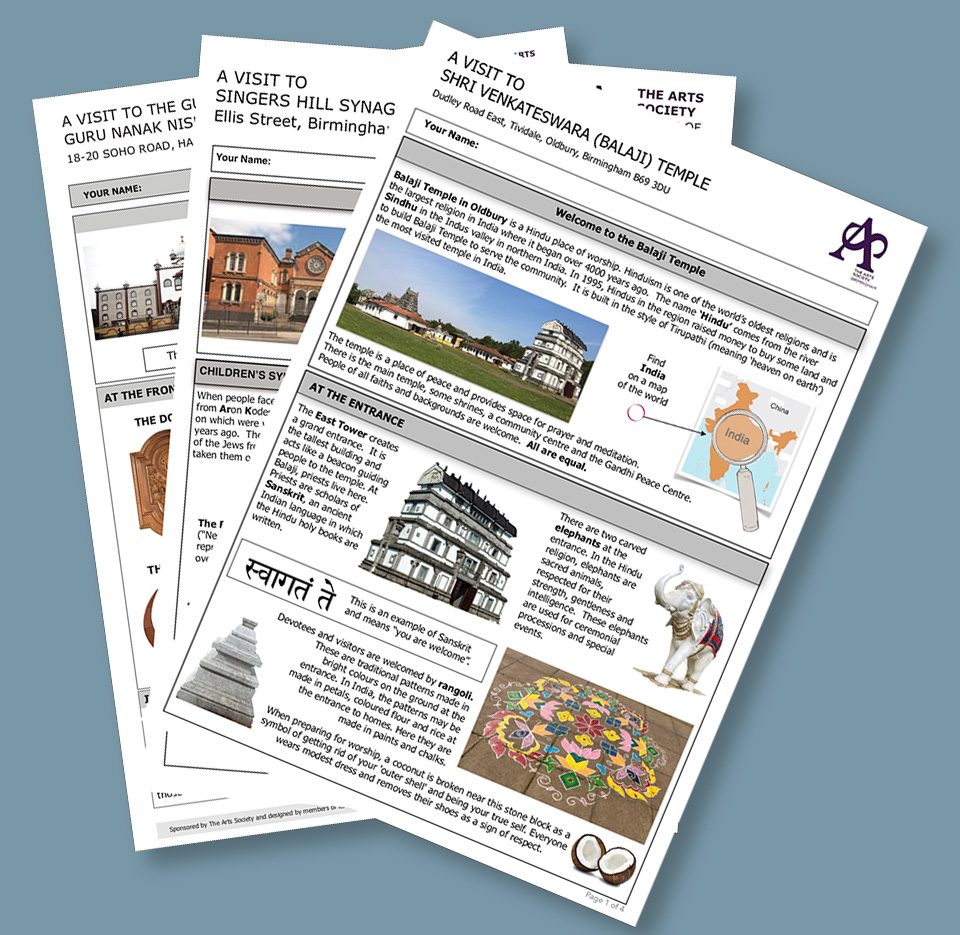
SCHOOL VISITS TO PLACES OF WORSHIP
AN AWARD WINNING PROJECT
Many of you may have seen the excellent article on this impressive award winning Project in the Summer 2022 edition of the Arts Society Magazine, and if you haven’t yet it is well worth reading for its account of the inspiring work carried out over the last five years by Liz Dancey and her team of volunteers from Birmingham and West Midlands Arts Societies. If you don’t still have a copy of the magazine to hand, the article can be viewed at: Reaching Out | The Arts Society .
More information about the project can also be found on the Heritage Volunteers page of this website and at:
https://birmingham-faith-visits.theartssociety.org/
Committee Vacancy
The Committee is continuing to look for a member to take on the role of Heritage Volunteering Representative.
If you might be interested in this and would like to know more, please contact Di Wardle at: secretary@theartssocietybirmingham.org